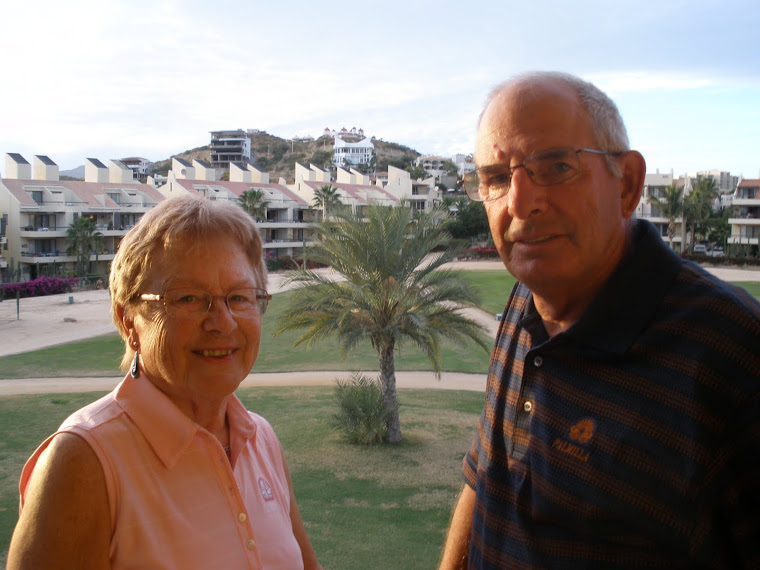
Peter and Marilyn

Peter and Marilyn
Christmas in San Jose del Cabo

Monday, October 18, 2010

Copacabana to La Paz


Friday, Oct. 15

Sorry about the sideways picture. And the double the posting before. I’m still learning.
This time I will try to post one picture from the Isle del Sol, the buses in the street when we were leaving Copacabana, (the burrow was in the last posting), and the bus backing up after taking the wrong turn.

We took a trip to the Isle del Sol. The guide to the ruins, Faustico, made reference to the pre-Inca society all along the way. The people living on the island who tend the land do so in the old way. Most speak only the Aymara language. We saw an elderly lady toiling the garden using a pole with a long blade crudely tied to the bottom. The ruins at the top we pre-Inca. You can understand the difference by the crudeness of the construction. What is really interesting is that at one time he entire island was underwater, but, also, that between sections of the island Jacque Cousteau went underwater and discovered a ruin which would have been constructed when this area was above water, of course. The artefacts are in a museum in La Paz. I think Peter is ruins/museumed-out for the moment, so I doubt we will see them. We walked about 50 minutes to the top. For his 1 ½ hour guide trip Faustico charged each of us the equivalent of $1.40. Some of the group began a three-hour hike to our second port-of-call, and they were sent off with “buena suerte”s in many languages. All but one of this group were twenty-years younger than our kids! Some burrows met us on the way down and it was obvious by their behaviour that they are used to getting treats from the visitors. As the guide okayed it, we gave them some crackers in exchange for a photo. At one point I was talking with the guide, practicing my Spanish, and was not paying enough attention to the rocky path and I went down on my right knee. I have had a little owie (sic) since. It didn’t bruise so nothing is broken. I was more silent the rest of the way down, probably to the guide’s delight!
We met a nice young British couple on the trip down. He had thanked me for translating some of the stuff for them. He is a teacher who has a new job starting in a few months and she has just completed a masters in some area of political science. We stopped for a beer while we awaiting our boat. We make two more stops to view ruins. We arrive, tired, back at Copacabana at 5:30. We still need to hike from the wharf to the hotel.
Before going for dinner, we check about reserving seats to La Paz the next day. It turns out the bus is “asiento libro” - right “first come first served”. We plan to be first!
We walk around the market area again, then go out for pizza. My tummy manages the wonderful hot chocolate (Chunks of real chocolate are put in a cup and hot milk added. Then you stir vigorously to melt the chocolate. They give you sugar, but I have never needed it.) but I can only manage one small slice of pizza. Luckily it is cheese only, so I take home for the bus tomorrow.

Copacabana


Thursday, Oct. 14


Oh, the buns and the freshly-squeezed fruit juices. The buns have crispy crusts and melt-in-your-mouth sour dough centres. I will miss both.
Our tour bus to Lake Titicaca is one of those two-door jobbies you see from the cruise ships in Cabo. We must visit the police station and the Immigration office on our way out of Peru, walk across the border, and visit the Immigration off ice in Bolivia. The fellow there thought I had an Australian passport and said, “kangaroos?”, I said, “ no, snow, canadiense!” We both had a good laugh. We are herded into small van buses for the last few minutes into Copacabana. On the map we have, it is only three blocks to our hostel. What it doesn’t show is that it al all uphill on cobble streets. At this altitude, we took the odd break as we hauled our luggage uphill. I had my two Eagle Creek pieces zipped together and at the first pause, I securely tied my Peruvian carry bag onto the handle. That made the going much easier.
This hotel/hostel is a little more rustic, but we have a view of the lake and it has a wonderful atrium with three groupings of comfortable chesterfields and coffee tables. Felipe and his wife who run the place are always busy with some chore. Felipe even clears tables at breakfast when it get busy. We walk down to the waterfront that has a beautiful beach but it is way too cold for swimming. After a light lunch we return to the hotel and crash for a couple of hours. The town is very small and built into the hill. There are virtually no private cars and only a few taxis. You simply walk up and down the centre off all the streets. One of the first things I noticed is the lack of bars on the doors and windows! That night, as the shops closed, one shop by the market had a few big items still outside and only a card-type table on its side instead of a door. What a concept. We were told by one of the guides that the pre-Spanish and still rural philosophy is: Don’t lie; Don’t be idle; and Don’t steal. We would all live a more contented life if this was everyone’s behaviour. Instead of doors, a stick diagonally across the doorway means nobody is home so don’t enter. We actually saw this a few times during the day in shops in Copacabana.

Puno


Wednesday, Oct. 15

Puno

Wednesday, Oct. 13
Today began with a box of unnecessary stuff and a few gifts starting the journey to Cathy’s place. We got the box at the corner mercado (I had the choice of three sizes!), and the front desk supplied the packing tape. In order to send it, I needed a photocopy of my passport and had to affix my index finger print to all five copies of the official sheet. Now, after over $75 cnd we hope it arrives in the two to three weeks the nice lady said. While Peter retrieved the copy, the clerk and I had a lovely conversation about our families. Women talk is universal.
We took a tour of a Uros floating island. Talking about having nothing. The entire family group live on an island. The one we visited was about 50 x 100 feet. Each couple have their own hut. They fish and shoot birds (with a musket). There was a pet flamingo, a puppy, and a cat kept as pets. They make cash through their handicrafts and tourist visits. I did buy an embroidered cloth which will have fond memories for me. Margarita dressed me in a local outfit over all the clothes I had on and Peter got a picture. We also took the ride to the next island in their fancy reed boat - you don’t pay if you don’t make it. I had to admire how hard Margarita worked rowing this large craft with the crudest of paddles. I will certainly be way more vocal when people whine about anything they don’t have in Canada. It makes our complex expansion seem quite excessive. The women on each island all wear the same brightly coloured dress skirt so even in town they know who is from which island. Ours wore a fluoresant pink which simply did not photograph truly.
That evening in our hotel we met a couple about twenty-years our junior who are from Nelson, New Zealand. Mike kept commenting that his wife and I were way to dangerous together. Anyway, we have an invitation to crash if we do get to Nelson in December.
It is certainly being proven to us that it is not the destination, but the journey that is important.
I want to take a moment to say some thank you -s. Eileen for the scarf I wear almost every day. Cathy for lending me her wool socks that I wear even to bed. Lach for recommending that we do not do the four-day Inca Trail and that we do go to the expense of buying the Eagle Creek Switchback luggage. Peter is still swearing at the day pack as it has too many zipper sections for him, but I love it as I zip the two pieces together for bus rides. Henry for recommending the Kindle which Peter is using everyday and is recommending to other travelers. Finally to our wonderful kids who chipped-in and bought the Kindle for their Dad and who were so encouraging that we should spend their inheritance and have the trip of a lifetime. There have been no hitches yet, but I am sure in the six + months there will be some, but who cares, it is just so much fun wandering.

Sunday, October 17, 2010

Cusco to Puno


Tuesday, October 12
Today we were at the bus station at 7 a.m. for the tourist bus to Puno on Lake Titicaca, the world’s highest fresh-water lake. The six-hour trip will take ten as we stop at historical features along the way. Of course, there will be other buses of tourists there as well as the local vendors selling the crafts at inflated prices.
We went through the pass at La Raya at 4313 metres. This is like putting another 2000 metres on top of Old Glory. This pass separates the Cusco and the Puno districts of Peru. Also, at this point, the high plateau that stretches to La Paz, Bolivia, begins. There were lots of vendors there and one lady was knitting very nice alpaca scarves going a mile a minute. I went over to watch her and commented on how quickly she could knit. Then I told her that I knit also and I asked her where I could purchase some wool. Of course, she had a bag with a few more skeins, so she sold me two as it would take only one to make a scarf. Being able to communicate in Spanish has been a real asset on this trip. Each day it becomes easier. Once you are not dealing directly with a tourist agent, there is no English.
After we descended from the Pass, we saw a huge storm to the southwest. As we approached the area it had past, there was actually snow on the ground! We came all this way to see snow.
All along the way, the farm people live as they did hundreds of years ago, except they often have electricity. In one whole area almost all the outhouses were made of brightly-blue-coloured corrugated steel. The others were lime green! The houses are surrounded by a wall where the cattle, llamas, alpacas or sheep, pigs, and chickens are kept at night.
Tonight we are living the life of luxury. The hotel is serious four star. Our dinner with a drink and a glass of complimentary wine was around thirty dollars total. The waiter even started a fire in the fireplace and brought a heater next to our table because I put on a skirt and dress shoes and he thought I might be cold.

Monday, October 11, 2010

Cusco to Machu Pichu


Monday, October 11

It has been a busy five days. Cusco is a vibrant little city. They have there share of beggars in the tourist area, but mostly they are old women and men. The Peruvians ignore them, so we do also. Before I forget, I want to thank Eileen for the wonderfully-warm scarf. It tucks away easily when not needed, but I have worn it almost every day. Yes, it is chilly here; no, down right cold. And Cathy, I wear your socks to bed most nights and today I wore them with my sandals as my other socks were in the laundry.
At 11,150 feet, Cusco is never really warm. When the sun comes out, it is easy to get burned as you don’t realize its power. I always wear sun block and today I wore a turtle neck, my warm sweater, and my jacket, as well as wool socks, long johns and my light nylon pants. Of course, the scarf finished the outfit. I was cozy.
On Thursday, we had a quiet day and arranged for a trip to the Sacred Valley Friday. We ate in a pizza place. Here they called the kitchen la cuyeria or “the place we cook cuy!“ The guide on our trip said that they love their pets so much that they eat them.
As we walked home from supper, the town was hopping. Peter pointed out that it reminded him of San Cristobel in Chiapas. It really does. About every second block in the center of town has a park and a fountain. Part of the excitement was that tomorrow is a national holiday they informally call Sailor’s Day.
The tiny streets in Cusco are very convoluted. To get the travel agent to book our tour, we spent more than five minutes going back and forth on one-way streets. We were not paying the fair, but the return trip cost 2.50 soles - about a dollar. As it turned out, it was an excellent tour.
The guide was a middle-aged Cuscano whose first language is Quechua. He spoke very good English and Spanish. We stopped at the ruins at Pisac, Urubamba, Ollantaytambo, and Cinero. Because of the travel agent we used, we had the swankiest restaurant in Urubamba for our included lunch. It really was upscale, so I used this for my main meal of the day.
The ruins were each different in there way, but each required lots of climbing. It was an informative and good exercise day. The ancient Peruvians were very smart as they built on the hills and used the fertile valley floor for agriculture. Maybe the Canadians should have thought of this when building, especially in the Fraser Valley.
Of course they had other reasons like; security from their enemies, security in the case of earthquakes (they built right on top and their houses moved with the tremor), and religious as they wanted to be closer to their gods.
The Urubamba River is quite substantial in this area. It snakes for 4700 km. through South American and joins into the Amazon. It is one of the longest rivers in the world. One thing that was pointed out to us was the capes worn by the indigenous women before and in the Spanish depiction of religious women symbolically was representing the shape of the mountains which were considered sacred by the original people. I can see why because they are surrounded by huge, almost vertically-sided mountains.
Saturday, October 9, we were picked-up at 6:30 a.m. for the trip to Agua Calientes/ Machu Picchu. I have my fourth meal of the stuffed potato for breakfast in the train station. Peter picks-up a couple of buns and coffee from the inevitable street vendors outside the station. Although many people appear to have been separated from their families, by the time the train pulls out, we are all organized and sitting together. Our seatmates are a lady from Lima who works (runs?) a travel agency and her 20 something son who is in his last year of law at university. Their English is very good. We get the name of a good cebiche restaurant in Miraflores for when we return to Lima. The boy has never been to Machu Picchu and is taking advantage of the long weekend, and still being a student, to see it. They are heading back to Cusco tonight. We will wander Agua Calientes today, and go up on the bus tomorrow. The train ride is supposed to be spectacular, but we saw most of the area yesterday. One very interesting building technique they used for the train travelling down the valley (which is very narrow and quite steep) is they stop parallel to a lower track, back up on a rail that descends, then go forward on the lower rail. It would be difficult with longer trains, but these excursion trains have only four cars.
At one point we stopped to let off the adventuresome people who were doing the four-day Inca Trail to Machu Picchu. They do see other ruins along the way, they go through spectacular scenery, but they carry nothing but themselves or small day-packs and use walking sticks. As we watched them coming off the trail the next day to a foggy, overcast Machu Picchu, most were not smiling, some had downright “what the hell did I do that for” expressions, and the porters were the only ones carrying anything of substance. We spoke with one guy who is in the British Army and really fit, and he said the second day (the hell day by all accounts) he was simply taking two steps forward and then leaning on his sticks for support while he caught his breath and pushed himself through the next two steps. Thanks Lach for telling us that this would not be a good idea for us.
At the station in Agua Calientes, we saw a girl with a poster from our hostel, but our names were not on the board. Peter asked her if she was from our place, and she nodded at us to wait behind her. After four of five minutes, the others had not arrived, so she strided uphill with us in tow. It was only two to three minutes to the hostel. We had an en suite and a window, our two requirements, and the place was spotless. There was breakfast included beginning at 4:30 a.m. We spent the rest of the day wandering around town and getting our tickets for the bus and the site entry. What we are saving on food, we are spending on tickets as everything has increased in price since we researched them.
We toured the town for a dinner place and found a reasonable place with an adobe oven. I had baked trout, the local specialty, and it was done to perfection. Peter has spaghetti which he said was fine. We got to bed early as we figured tomorrow will be a tiring day.
Sunday, Machu Picchu day! Luckily, Peter awake early as the alarm was set for the p.m. When we struggled downstairs, all the lights were off. It turns out, the girl who is supposed to make breakfast didn’t show up. The main lady quickly made us coffee, freshly-squeezed orange juice, scrambled eggs, and buns she had to go out to get as we ate. We left our backpacks at the hostel, and wandered down to the bus in misty-rain. Not a good omen. The buses leave about every three minutes, so we did not have to wait long. Now, the trip up the fourteen or fifteen switch-backs and curvy single lane road that follows the contours of the mountain is just a little hairy. Ruth would be advised to close her eyes and not even to peak! Of course, you have the option of walking the steps up, but that would probably be a two-hour adventure. I thought of Tig and Pat and wondered if there is a Machu Picchu grind! The line-up to get in was long, but moved quickly. We got our tickets stamped to go up Huayna Picchu, but took a wrong turn and ended up going in the opposite direction up the trail that the hikers use to come into the site. Of course, it didn’t help that you could not see Huayna Picchu because of the low-flying clouds. We walked about twenty minutes or so, and were told by a guide there was a gate about forty minutes to one hour away - all up hill. To heck with that. We made our way back to a sign that pointed to the tour direction and began to explore the site. As we had learned the day before, the cities were always constructed with an agricultural zone, a housing zone, and a religious zone. At Machu Picchu today, they use llamas to cut the grass. They are very efficient grazers. Of course, in the Inca and before time, the terraces were planted with mostly potatoes. They had a way of freezing them so they lasted many (sometimes fifteen) years, and when boiled to eat, it only took three or four minutes to cook them. They had huge storage areas where they kept food for the years when the harvest was bad.
In the residential zone, the residents had a fresh-water system that actually came right into the homes. The water was also stores in reservoirs. Even today, you can see how the channels distributed the water - especially on a rainy day like we had.
The stone work in the religious zone is of a much higher standard than the others. The base stones of the buildings are huge, smoothed, and fit together without any space between. There is an area where there are boulders which were being worked on when the Incas abandoned Machu Picchu. I looked at the total of the city (between three and five thousand people lived here), and it is obvious the place was started before the Incas invaded the area. They were here for less than 100 years. There is no way so much development could have occurred in that length of time. I bought a book today about the history of the ancient kingdoms, so I hope to learn more.
The day itself began foggy, then became sunny enough that I folded up my pants, then became downright ugly. You will have to image Peter and I hunkered-down under an ancient rock in the carving area, each sitting on a small rock, eating lunch. It was raining too hard to ask anyone to take a picture. By the time we made our way to the Huayna Picchu entrance, we decided it would be foolhardy to actually attempt the climb. Sometimes you simply must put common sense before desire.
Yes, you can’t visit Peru without seeing Machu Picchu, but the spiritual side of the place is totally lost in the hoards of people scampering all over the place. It is definitely a cash cow for a country which needs the infusion of money outside of Lima.
The trip down on the bus surpassed the assent. The rain had slickened the road. I took consolation in the fact that busses going over the edge would be bad for publicity and costly to replace.
The train trip back only takes you to Ollantaytambo, so there is a two-hour taxi drive to Cusco. My seat mate said that he had paid for a taxi and if there was room we were welcome to join him. His taxi never showed up, so we shared one back. Two hours in the dark in a nail-biting, pass-anywhere trip. We arrived safely, so I guess I shouldn’t criticize. We fell into bed exhausted and did not set the alarm for this morning.
We got the laundry done and had a lazy day. I am going to miss the warm, snugly bed here at La Rosal. We have thin sheets, then two wool blankets as thick as the best quality Hudson Bays, then a thick, puffy quilt. Once you are within this cocoon, it is heaven. We are up early and off to Puno and the floating island tomorrow.

Thursday, October 7, 2010

Lima & Cusco

Wednesday, October 6

We have arrived in Cusco after a hurried visit to Lima. We will have a few days there next month and hope to see some of the museums.
Monday, we spent time on new Express bus system into the downtown area. For 3 soles ($1.20) we went return to downtown from Miraflores. It is so new that even the locals are asking for help at the stations! The bus travels down the centre lane of an expressway, with walkovers to stations every few miles. They have advertisements in plants along the edge of the expressway. We saw gardeners trimming the plants to keep the “writing” tidy. It is amazing what you can do with cheap labour.
Near our station and on the "wrong side" of the highway, there is a central market that makes the one in San Jose look like a Safeway. In the meat area, there is every part of an animal displayed. Obviously, they eat everything. We noticed from the menus in a few restaurants that liver is an everyday part of the diet. We bought some fruit and, near the market, we found an mini-mercado that had good prices on beer and wine. The owner assured us we would pay more in the upscale area where we are staying - on the right side of the tracks.
As the municipal elections were on Sunday, no liqueur was allowed to be sold until after noon on Monday. Well, as one waitress said in a restaurant - no beer because it comes in bottles, but other drinks are served in cups. Sounds like Mexico.
We walked by the Justice building, a huge, very imposing structure and there was a red carpet down the front steps. Peter asked a young man who was guarding an entrance why it was there. He said that the newly elected mayor (Presidente) would be arriving. Unfortunately, he or she was late so we didn’t stay to watch.
Everyone dodges traffic here and we are getting pretty good at it. Luckily, most streets are one way, so you need look only in that direction. Otherwise, the drivers are very law-abiding as they all seem to buckle-up and you don’t see them talking on cell phones. Of course, they would be taking their lives in their hands if they did because they drive at excessive speeds, dodge in and out, and blow their horns incessantly.
In the evening, we looked at the artisan’s stands in Kennedy (of John fame) park and found a nice little place for dinner. I had my first pisco sour and I’m hooked.
Tuesday, we awoke to a herd of French-Canadians trudging down to breakfast. Afterwards, they viewed a video of Machu Picchi. We never saw them again, so we assume they pushed on.
After leaving our dirty stuff at the laundry and having breakfast, we headed back to el central to see the changing of the guard at the Presidential (of the country) Palace. There was a marching band, much straight-leg kicks by the guards (German style), and much pomp. There were way more Peruvians there than foreigners, so it is something quite special. It lasted over 30 minutes. We did get some good pictures. Peter and I posed with a shield-carrying army fellow who was part of the group keeping people across the street. There is a huge army and police presence, but they are friendly.
On a typical cheap-store street, I managed to buy two warm pullovers for the equivalent of $5 each. Finally I will be warm! Peter needed some relief, so we popped into the Bolivar Grand Hotel which serves high-tea and must have been spectacular in its day. I will post a picture of the atrium.
When we finally got home there was a message that we had just missed Nancy, Rosa’s mother, by fifteen minutes in the morning. As Peter was going out to pick-up the laundry, she arrived back. It was so thoughtful of her to come all this way. She does not live anywhere near Miraflores! We had a nice chat and she told me that Rosa is returning to Lima in January to wed her Canadian fiancĂ©e. Nancy is quite excited. We all went to dinner. I got to try authentic Peruvian fare. The appetizer was a yucca dish with a special dipping sauce. The main course was cuy (whole guinea pig - I let Nancy eat the head). For dessert we had something like a pudding made with sweetened-condensed milk and topped with whipped cream. Luckily we shared everything except the dessert. Peter had a bit of the appetizer, but then just had lasagne. We were somewhat late to bed considering we had to be up by 4:30 this morning.
Today, I have been drinking coca tea, chewing coca leaves, and taking our medication for altitude sickness. Hope it works. As Cusco is very hilly, you do go up the hills slowly. I am trying to consciously walk at a slower pace. Our hotel is connected to an old church and was a convent in past. There appears to be very few, if any, people staying here. We will see at breakfast as it is included.
I posted 10 pictures, but that whole posting got lost. The computer went off unexpectedly, and tat may have been the cause. Because picutes take so long to download, I will re-post them tonight. If anyone can instruct me on how to get a tag on the pictures, I would appreciate it.
Be back later.
I may or may not get this posted tonight as I am very tired. I will download some pictures and finish-up in the morning.